

Table of Contents
- How Enzymatic Extraction Works
- Solvent Extraction Methods Explained
- Enzymatic Extraction Benefits and Trade-Offs
- Extraction Yield and Purity: Direct Comparison
- Enzymatic Extraction vs Solvent-Based: Applications and Scale-Up
- Choosing the Right Extraction Method for Your Needs
- Frequently Asked Questions
Last Updated: October 12, 2026
How Enzymatic Extraction Works
Enzymatic extraction solvent based methods use enzymes to break down plant cell walls and release target compounds without harsh chemical solvents. Their specificity allows selective degradation of cellular structures, releasing bioactives into a liquid medium. At Aftology, enzyme-assisted extraction is a core part of our proprietary fermentation technology.
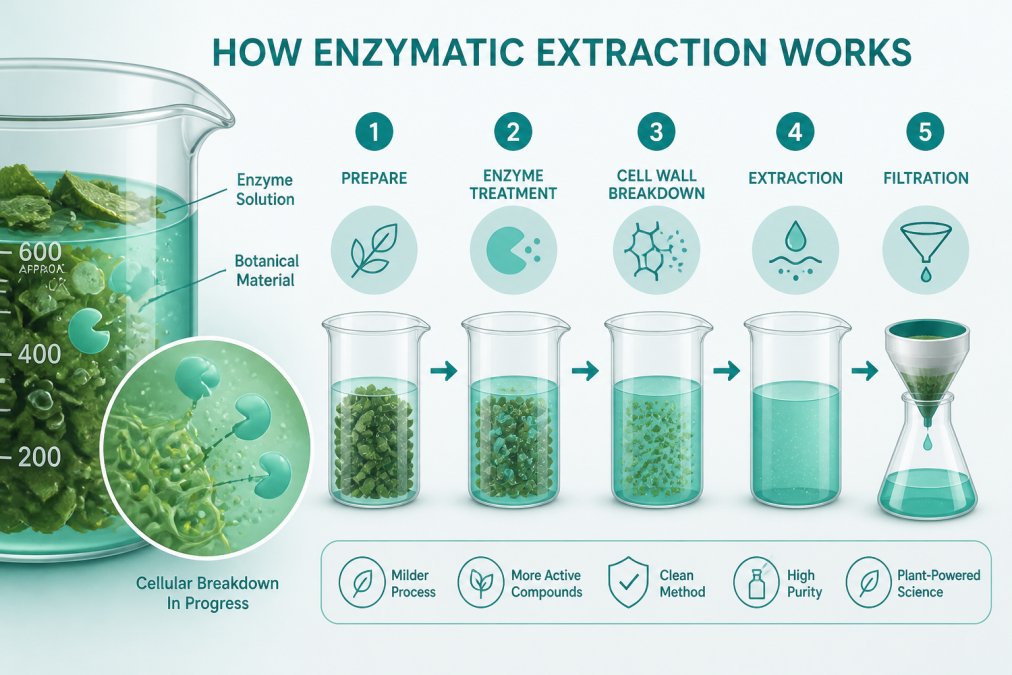
Enzyme selection and operating conditions
The enzyme choice determines what gets extracted and how efficiently: cellulases break down cellulose, pectinases degrade pectin, and proteases break down proteins.
Most enzymatic extraction solvent based approaches occur at mild temperatures (35-50°C) and neutral to slightly acidic pH, unlike traditional solvent-based methods that often require heat or aggressive chemistry.
Processing time ranges from hours to days depending on feedstock and target compounds.
Cell wall disruption and mass transfer
Cell walls protect the cell's interior but also trap target compounds.
Mass transfer, the movement of dissolved compounds from solid plant material into the extraction liquid, is slower with enzymatic methods than aggressive solvents.
Solid-liquid contact surface area and agitation speed affect mass transfer rates. Better mixing speeds extraction but risks damaging enzyme proteins at high shear rates.
Solvent Extraction Methods Explained
Solvent-based extraction relies on "like dissolves like": polar solvents dissolve polar compounds, nonpolar solvents dissolve nonpolar compounds. The solvent penetrates plant material, dissolves targets, then is separated from solid residue.
Conventional solvent-based approaches
Traditional solvent extraction uses organic solvents like ethanol, hexane, or acetone to rapidly dissolve bioactives from plant biomass, usually in minutes to a few hours.
The speed comes with trade-offs: solvents extract unwanted compounds alongside targets, waxes, chlorophyll, other plant material, reducing purity. Residual solvent must be removed by evaporation, and heat used for extraction and removal can degrade heat-sensitive bioactives.
Solvent types and their roles
Ethanol is a polar, food-grade solvent widely used in botanical extraction, effective at dissolving water-soluble and moderately polar compounds, often requiring elevated temperatures.
Hexane is nonpolar and excellent for lipids and lipophilic compounds.
Acetone is a strong polar solvent that dissolves many compounds quickly.
Water is the safest but least selective solvent.
Enzymatic Extraction Benefits and Trade-Offs
Understanding the real advantages and limitations of enzymatic extraction versus solvent-based methods clarifies when each approach makes sense.
Selectivity and bioactive compound preservation
Enzymatic extraction's defining advantage is selectivity: enzymes target specific cell wall components, releasing target compounds while leaving unwanted material behind, yielding cleaner extracts with fewer impurities and higher bioactive concentration.
Mild operating conditions preserve heat-sensitive compounds, vitamins, antioxidants, volatile phytochemicals, making enzymatic extraction preferred when retaining the full spectrum of bioactives matters.
Processing time and energy consumption
Enzymatic extraction typically requires 6-48 hours of contact time depending on enzyme system and feedstock; solvent extraction often completes in 1-4 hours.
Enzymatic extraction uses less heat, just enough to maintain optimal enzyme activity, while solvent extraction requires elevated temperatures for extraction and recovery, consuming more energy per kilogram of extract.
Extraction Yield and Purity: Direct Comparison
Both methods can achieve high recovery rates, but they differ in what gets recovered, how consistently, and at what cost.
What drives yield in each method
Enzymatic extraction yield depends on:
- Enzyme cocktail composition, cellulases, hemicellulases, pectinases, and proteases each attack different cell-wall polymers. A cocktail matched to the feedstock's dominant wall components typically outperforms a single enzyme.
- Enzyme dose, higher dose usually increases rate and extent of cell-wall breakdown, but with diminishing returns and rising cost.
- pH and temperature, each enzyme has an optimum; running outside it reduces activity and yield.
Solvent extraction yield depends on:
- Solvent polarity match, 'like dissolves like' governs which compounds are recovered. Ethanol recovers a broad polar-to-moderately-polar range; hexane targets lipids and lipophilic compounds; water recovers water-soluble compounds.
- Temperature, higher temperature increases solubility and mass transfer but risks degrading heat-sensitive targets.
- Solvent-to-feed ratio, more solvent generally improves recovery up to a point.
Recovery rates across feedstocks
Enzymatic extraction typically recovers a narrower, more defined set of target compounds because enzymes act selectively on cell-wall components.
Solvent extraction often reports higher total recovery because solvents are less selective, they pull target compounds plus a broader range of co-extractives.
Recovery consistency also differs. Solvent extraction tends to be more predictable across feedstocks, while enzymatic extraction's performance is more feedstock-specific, which is why pilot testing matters.
Extract quality, purity, and residual concerns
Enzymatic extracts typically contain fewer non-target co-extractives because the enzyme acts on specific wall components, which can mean less downstream purification.
Solvent extracts require removal of residual solvent to meet safety and regulatory limits. Residual-solvent testing is a standard quality-control step, and the specific limits depend on the solvent and intended use.
Shop Liposomal Magnesium Glycynate Chloride Cream →
Direct comparison table
| Comparison Factor | Enzymatic Extraction | Solvent-Based Extraction |
|---|---|---|
| Typical processing time | Hours to days (often 6-48 h) | Minutes to a few hours (often 1-4 h) |
| Selectivity | High, targets specific wall components | Lower, broad solubility-based extraction |
| Key process variables | Enzyme type, dose, pH, temperature, time | Solvent polarity, temperature, ratio, agitation |
| Extract purity | Often higher; fewer co-extractives | Requires purification to remove co-extractives |
| Heat-sensitive compounds | Preserved by mild conditions | At risk if elevated temperature is used |
| Residual concerns | Enzyme protein, buffer salts | Residual solvent |
| Downstream steps | Inactivation, filtration, polishing | Solvent removal, residual testing |
| Energy profile | Lower heating demand | Higher, heating for extraction and recovery |
| Feedstock sensitivity | High, performance varies by material | Lower, more consistent across feedstocks |
| Scalability constraint | Reactor volume vs. cycle time | Solvent recovery and safety infrastructure |
How to compare the two fairly
To make a valid comparison for your own feedstock:
- Define the target compound or compound class and the required purity.
- Run both methods under their respective optimized conditions, not one method at its best and the other at a default setting.
- Measure recovery of the target compound specifically, not total extractable mass.
- Account for downstream steps needed to reach your specification, including enzyme inactivation or solvent removal.
- Compare cost per unit of usable, specification-compliant extract, not cost per batch.
This avoids the most common error: treating a higher total recovery number as proof of a better process when the extra material is unwanted.
Enzymatic Extraction vs Solvent-Based: Applications and Scale-Up
Different industries favor different extraction methods based on their requirements and economics. The sections below compare the two routes at the level that decides the choice: equipment, operating cost drivers, and behavior from bench to commercial scale.
Food, pharmaceutical, cosmetic, and botanical industries
Food and beverage: Enzyme-assisted extraction is well established in juice and plant-protein processing, where cellulases, pectinases, and hemicellulases improve yield and clarity while preserving flavor and heat-sensitive nutrients.
Pharmaceutical: Solvent extraction remains traditional, partly because pharmacopeial monographs, validation protocols, and impurity limits are built around it.
Cosmetics and skincare: Enzyme-assisted extraction is gaining traction in clean-beauty formulations because it avoids residual organic solvent and preserves delicate actives. This approach is particularly valuable in oral care products, where botanical extracts can be formulated alongside functional ingredients like 10% Nano-Hydroxyapatite Toothpaste to combine the benefits of clean extraction with evidence-based actives.
Botanical and herbal products: Enzyme-assisted extraction is often preferred for traditional herbal extracts where the full spectrum of plant compounds is therapeutically relevant, provided the enzyme cocktail does not alter the target profile.
Equipment and process requirements
Enzymatic route:
- Jacketed, agitated reactor or stirred-tank vessel with tight temperature control (typically 35-50°C) and pH monitoring
- Enzyme dosing and metering system; enzyme activity must be verified per lot
- Inactivation step (heat, pH shift, or filtration) before downstream processing
Solvent route:
- Extraction vessel rated for the chosen solvent, with vapor containment
- Condenser and solvent-recovery system (often 90%+ recovery is the design target)
- Explosion-proof electricals and ventilation where flammable solvents are used
The solvent route's capital cost is dominated by recovery, containment, and safety infrastructure. The enzymatic route's is dominated by reactor volume and residence time, you need more tank for the same daily output because each batch runs longer.
Cost-effectiveness and process economics at scale
At laboratory or pilot scale, enzyme-assisted extraction usually costs more per unit because enzyme preparations and labor dominate, and solvent extraction looks cheaper on paper.
At commercial scale, the picture is more balanced:
- Enzyme cost: The largest variable cost in the enzymatic route. Cost per kilogram of extract depends on enzyme activity, dosing rate, and whether the enzyme can be reused or immobilized, which materially changes the economics.
- Solvent cost: Solvent itself is often cheap, but recovery, losses, energy for evaporation, and disposal add up. A closed-loop system recovers most solvent, but the recovery equipment and its energy demand are ongoing costs.
- Energy: Enzymatic extraction holds mild temperatures, so heating energy is low. Solvent extraction requires heating for extraction and solvent removal, so energy per kilogram of extract is higher.
The break-even point depends on target-compound value, enzyme cost, solvent-recovery efficiency, energy prices, and local labor rates. High-value botanical extracts can justify the enzymatic route's longer cycle time; high-volume, low-margin commodities often favor solvent extraction's throughput.
A practical scale-up checklist
Before committing capital, run a pilot with both routes on your actual feedstock and target compounds. Measure:
- Enzyme dose and cost per kilogram of extract at your target yield
- Solvent consumption and recovery rate per batch
- Energy input per kilogram of extract for each route
- Cycle time and effective daily throughput per unit of vessel volume
- Downstream steps required to hit your purity and residual specifications
- Waste streams and disposal costs for each route
A pilot trial with both methods provides the data needed to make an informed decision rather than relying on generalized claims.
Choosing the Right Extraction Method for Your Needs
The decision between enzymatic extraction and solvent-based extraction depends on your specific situation, not on a universal "best" method.
Feedstock compatibility and target compounds
Start with your feedstock and target compounds. Some plant materials respond better to enzymatic degradation; others are better served by solvent extraction.
Understand what you're extracting. If you need the full spectrum of plant compounds, enzymatic extraction's selectivity becomes a limitation. If you need specific bioactives and want to minimize impurities, that selectivity is an advantage.
Common mistakes in method selection
A common mistake is choosing based on processing time alone.
Another mistake is assuming higher recovery rates always mean better economics.
The biggest mistake is not testing both methods with your specific feedstock and target compounds. A pilot extraction trial with both methods provides the data needed to make an informed decision.
Choosing between enzymatic extraction and solvent-based extraction comes down to matching your process to your product goals. If you're formulating botanical skincare or oral care products where ingredient quality and bioactive preservation drive efficacy, enzymatic extraction aligns with clean formulation principles.
Frequently Asked Questions
What is the main difference between enzymatic extraction and solvent-based extraction?
Enzymatic extraction uses enzymes to break down cell walls and release target compounds, while solvent-based extraction dissolves bioactive compounds directly from plant material using chemical solvents. Enzymatic methods are highly selective and preserve heat-sensitive compounds, but typically require longer processing times. Solvent extraction is faster and achieves high recovery rates, but may leave residual solvent and degrade some phytochemicals. The choice depends on your target compound, feedstock, and whether selectivity or speed matters more.
What are the advantages of enzymatic extraction for botanical ingredients?
Enzymatic extraction offers several key benefits: it selectively releases target compounds while leaving unwanted plant material behind, reducing downstream purification needs. Enzymes work at mild temperatures and pH levels, preserving sensitive bioactive compounds and phytochemicals that solvents might degrade. The process generates minimal waste and no residual solvent contamination. For cosmetic and supplement formulations where ingredient integrity matters, enzymatic extraction delivers cleaner, more potent extracts with better biological activity.
Can enzymatic extraction replace solvent-based extraction entirely?
Not universally. Enzymatic extraction excels for certain feedstocks and target compounds, particularly those sensitive to heat or chemical degradation, but solvent extraction remains superior for others. Some plant materials require the penetrating power of solvents to achieve economical recovery rates. Solvent methods also process faster at scale, which matters for high-volume production. The best approach often depends on your specific botanical ingredient, desired purity level, production volume, and regulatory requirements for your final product.
What factors determine which extraction method is best for a botanical ingredient?
Key factors include: the target compound's chemical properties and heat sensitivity; the plant material's cell structure and moisture content; required extraction yield and purity; processing speed and throughput needs; cost constraints and equipment investment; regulatory standards for your end product; and whether residual solvent is acceptable. For heat-sensitive phytochemicals and premium skincare formulations, enzyme-assisted extraction often wins. For high-volume commodity extracts where cost and speed dominate, solvent methods may be preferred. Pilot testing both methods on your specific feedstock provides the most reliable answer.