

Table of Contents
- Understanding Enamel Erosion and Remineralization
- Signs to Discuss With Your Child's Dentist
- What Nano-Hydroxyapatite May Support
- Step-by-Step Brushing Technique
- Supporting Cavity Prevention
- Addressing Sensory Issues and Building Your Routine
- Common Mistakes to Avoid
- Frequently Asked Questions
Last Updated: October 6, 2026
Understanding Enamel Erosion and Remineralization
Enamel erosion is loss of tooth structure caused by acid. Missing enamel cannot regrow through toothpaste use. Remineralization is different: it supports mineral recovery in early demineralized areas where tooth structure remains. A pediatric dentist can assess which process is affecting your child's teeth.
Nano-hydroxyapatite is a calcium-phosphate mineral similar to the mineral in teeth. It may support remineralization and may help cover exposed dentin tubules, potentially helping manage sensitivity. These potential effects do not establish guaranteed deep repair, cavity reversal, or suitability for every child.
What happens when enamel erodes
Acid exposure can contribute to loss of tooth mineral. Dietary acids, reflux, and vomiting can cause erosion, while acids produced by plaque bacteria contribute to tooth decay. These conditions can overlap but are not interchangeable diagnoses.
Factors worth discussing with your child's dentist include frequent sugary or acidic drinks, reflux or repeated vomiting, dry mouth, and forceful brushing. Persistent symptoms need assessment rather than a home-treatment trial.
Considering fluoride-free care
Hydroxyapatite is studied for remineralization, but evidence depends on the specific formula, population, and outcome. This guide does not establish that a fluoride-free product gives every child cavity protection equivalent to fluoride toothpaste.
Before replacing recommended fluoride care with fluoride-free enamel care, ask your child's dentist about their age, cavity risk, and suitable products. A concern about swallowing is a reason to discuss appropriate amounts and supervision, not to assume another toothpaste is safe to swallow.
Signs to Discuss With Your Child's Dentist
White spots, chalky patches, discoloration, sensitivity, pitting, or transparent-looking edges deserve professional assessment. They can have different causes, including early decay or developmental enamel changes, and do not confirm erosion on their own.
Do not rely on color or shape alone to distinguish a cavity from erosion. Early decay does not always look dark or contain a visible hole. A dentist can identify the cause and recommend appropriate treatment.
Sensitive teeth may be associated with exposed dentin tubules, but other conditions can cause pain. Tubules are in dentin, not enamel. Hydroxyapatite may help cover exposed dentin tubules; it should not be presented as a guaranteed quick solution for a child's symptoms.
What Nano-Hydroxyapatite May Support
Nano-hydroxyapatite may support remineralization of early demineralized areas and sensitivity management. Its presence alone does not establish that a toothpaste repairs structural loss or prevents cavities as effectively as another product.
The linked video's title uses the word "rebuilds." Here, remineralization means supporting mineral recovery in remaining tooth structure, not regrowing enamel that has been lost.
Why concentration and particle size matter
Aftology's toothpaste contains 10% nano-hydroxyapatite and uses 20 nm rods as a deliberate formulation choice. Particle size matters alongside shape, dispersion, concentration, and the complete formula.
Smaller size alone does not guarantee better results. Larger particles should not be described as ineffective simply because of size, and lower-concentration products should not be dismissed without relevant comparative evidence. Ten percent is not a universal minimum for remineralization or proof of pediatric suitability.
Remineralization and Its Limits
Gentle brushing removes plaque; it is not intended to open tubules or create pathways for particles. Hydroxyapatite is studied for mineral deposition and may help cover exposed dentin tubules. These potential mechanisms do not guarantee that particles penetrate deeply or become part of tooth structure in every user.
There is no fixed schedule for sensitivity relief or fading white spots. Changes in appearance or comfort do not prove structural repair. A developed cavity or lost enamel needs dental assessment rather than relying on toothpaste to rebuild it.
Step-by-Step Brushing Technique
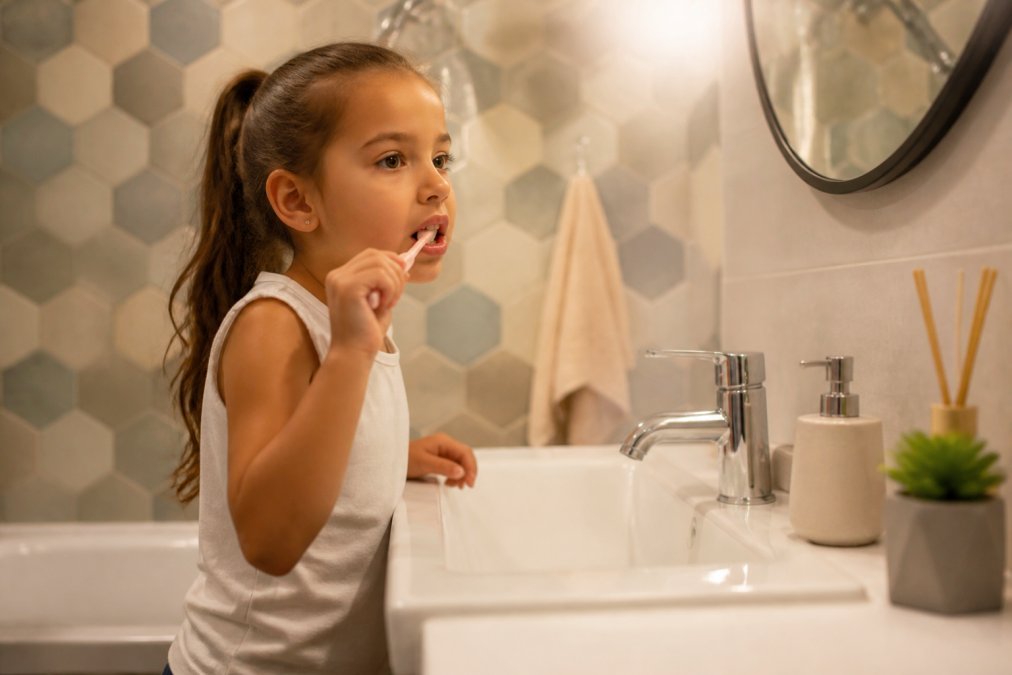
Gentle, thorough brushing supports cleaning without unnecessary force. Help or supervise your child as needed for their age and ability.
Gentle brushing technique
Step 1: Choose a suitable toothbrush. Use soft bristles and replace the brush when worn or as recommended.
Step 2: Use an appropriate toothpaste amount. Follow the product's age directions and your child's dentist's advice. Do not increase the amount to try to accelerate results. Ask about a suitable routine if your child cannot spit reliably.
Step 3: Position the brush gently. Angle it toward the gumline as your dental team advises, without pressing hard.
Step 4: Use small, gentle motions. Avoid forceful scrubbing. Pain during brushing should not be treated as normal or as evidence of healing.
Nano-Hydroxyapatite Toothpaste →
Step 5: Clean all tooth surfaces. Aim for two minutes, twice daily, with age-appropriate help. Include outer, inner, and chewing surfaces.
Step 6: Encourage spitting. Do not encourage swallowing toothpaste. Follow product directions and dental advice about rinsing rather than assuming prolonged residue guarantees better results.
Timing and frequency
Build a twice-daily routine, including before bed. Regular brushing supports oral health but does not guarantee a particular result.
Ask your dentist about brushing timing after acidic foods, reflux, or vomiting. Rinsing gently with water after an acidic exposure may help clear residue; avoid forceful brushing on affected teeth. Repeated reflux or vomiting also warrants medical advice.
Supporting Cavity Prevention
Fluoride toothpaste has established evidence for cavity prevention. If you prefer fluoride-free care, discuss that choice with your child's dentist rather than assuming diet and a mineral toothpaste fully replace recommended preventive treatment.
Diet and enamel health
Limit frequent sugary drinks and repeated acidic exposures. Offer balanced, age-appropriate meals and snacks, including suitable calcium and phosphorus sources. Food choices support general nutrition and oral health, but do not guarantee enamel repair or cavity prevention.
Consider water instead of frequent juice, soda, or sports drinks. Sticky sweets and prolonged sipping may increase exposure; discuss practical changes that fit your child's nutritional needs.
Daily habits and acid exposure
Water can help clear food and acidic residue but does not replace brushing or interdental cleaning. Persistent dry mouth, reflux, or vomiting deserves professional advice.
Do not add mouthwash for a young child without checking age restrictions and dental advice, especially if the child cannot spit reliably. Fluoride-free mouthwash is not automatically safe to swallow or necessary for enamel care.
Addressing Sensory Issues and Building Your Routine
Taste and texture can make brushing difficult. Work with your child's preferences while maintaining an age-appropriate routine recommended by their dental team.
Making brushing work for sensitive kids
Ask about a suitable brush and a tolerated toothpaste. Keep the amount within age and product guidance rather than increasing it as a sensory exercise. A pediatric dentist can help adapt the routine for sensory sensitivities.
Tracking changes and seeking advice
Note discomfort, visible changes, and situations that trigger symptoms. Do not assume white spots must fade or sensitivity must improve by a particular week. Observations help your dentist assess the problem; they are not proof of remineralization.
Follow the product's expiry and storage directions rather than assuming every tube loses potency after a fixed number of months. Seek advice for persistent symptoms instead of repeatedly changing products or blaming missed brushing for lack of improvement.
Common Mistakes to Avoid
Avoid treating fluoride-free as a swallowing-safety guarantee, using concentration as proof of effectiveness, or waiting through a promised repair timeline when your child has pain. Swelling, significant pain, or signs of infection need prompt assessment.
Frequently Asked Questions
What are the signs of enamel erosion in children?
Sensitivity, discoloration, pitting, or transparent-looking edges can warrant assessment, but none confirms erosion alone. White spots may have several causes, including early decay. A dentist can distinguish erosion, decay, and developmental changes and recommend care.
What can nano-hydroxyapatite toothpaste support?
It may support remineralization and may help cover exposed dentin tubules. Tubules are in dentin, not enamel. Aftology uses 10% nano-hydroxyapatite and 20 nm rods; these specifications alone do not guarantee superior results or suitability for every child. Toothpaste cannot regrow missing enamel or restore a developed cavity.
Can diet influence enamel health in children?
Frequent sugary or acidic exposures can affect tooth health. Balanced nutrition and suitable hydration support general health and oral care, but dietary changes do not guarantee repair or replace brushing, dental reviews, or recommended preventive treatments.
How long before fluoride-free enamel care shows results?
There is no fixed timeline for every child. Results depend on the complete formula, tooth condition, and cause of symptoms. Improved comfort or appearance does not prove structural repair. Have persistent pain or visible changes assessed rather than waiting for a promised result.