

Table of Contents
- What Is Nano-Hydroxyapatite?
- What You'll Need Before Starting
- Step-by-Step Brushing Technique
- Contact Time and Product Directions
- Hydroxyapatite and Fluoride
- Daily Use and Safety
- Your Post-Brushing Routine
- Common Mistakes to Avoid
- Frequently Asked Questions
Last Updated: October 6, 2026
What Is Nano-Hydroxyapatite?
Nano-hydroxyapatite is a calcium-phosphate mineral similar to the mineral in teeth. It may support remineralization and may help cover exposed dentin tubules, potentially helping manage sensitivity. Tubules are in dentin, not enamel.
Supporting early mineral loss is different from regrowing missing enamel or restoring a developed cavity. Sensitivity can have several causes, including exposed dentin, decay, cracks, or other dental problems. Toothpaste does not diagnose or treat every cause.
Aftology's 10% nano-hydroxyapatite toothpaste uses 20 nm rods as a deliberate formulation choice. Particle size matters alongside shape, dispersion, concentration, and the complete formula. Neither smaller size nor 10% concentration alone guarantees superior results. Lower-concentration products should not be dismissed without relevant comparative evidence.

There is no fixed timeline for sensitivity relief or remineralization that applies to everyone. Improved comfort or appearance does not prove structural repair. Persistent, sharp, or worsening pain deserves dental assessment.
What You'll Need Before Starting
For a routine using nano-hydroxyapatite toothpaste, choose a soft-bristled toothbrush, an appropriate toothpaste, and a timer to support thorough cleaning.
Aftology's 10% Nano-Hydroxyapatite Toothpaste is one fluoride-free option. Concentration is not a universal effectiveness threshold or proof that a product meets your cavity-prevention needs. Ask your dentist about a suitable routine, particularly with frequent cavities or dry mouth.
Special filtered or distilled rinse water is not required by this guide. Discuss whitening or abrasive products with your dentist if sensitivity is a concern rather than assuming every whitening treatment causes structural damage.
Step-by-Step Brushing Technique
Step 1: Apply the Right Amount
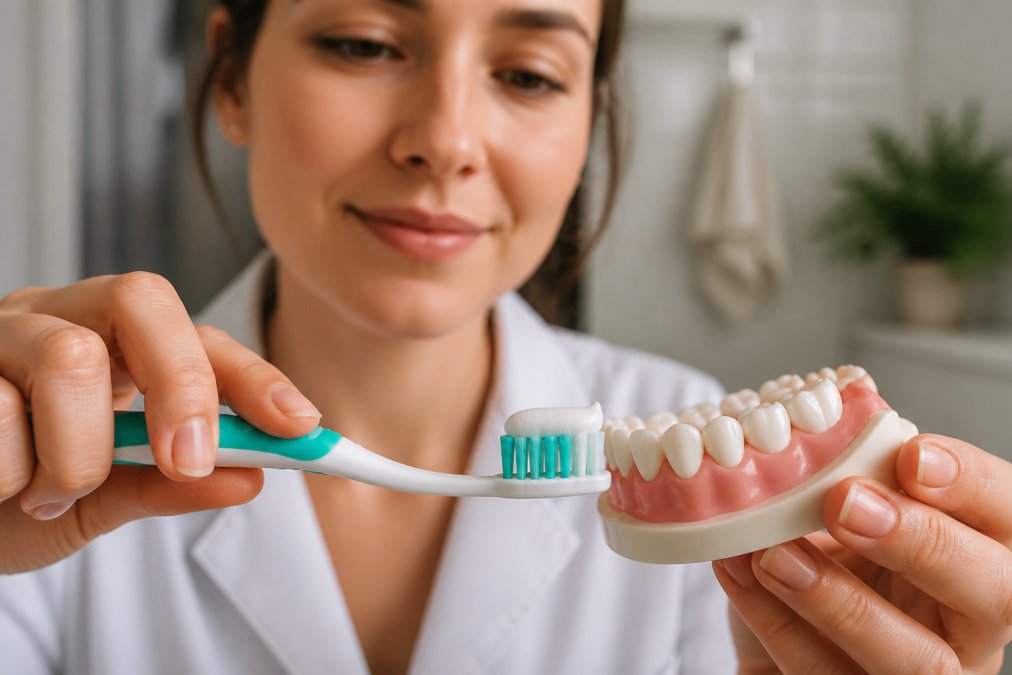
Follow the product's directions and age guidance. More toothpaste does not guarantee faster results. Ask your dentist about suitable products if you have sensitive gums or difficulty tolerating brushing.
Step 2: Brush With Gentle Pressure
Angle the brush toward the gumline and use gentle, small motions. Avoid forceful scrubbing. Sensitivity does not always originate at the gumline, and painful brushing is not evidence that treatment is working.
Step 3: Clean All Surfaces
Brush for two minutes, twice daily, covering outer, inner, and chewing surfaces. Do not assign most brushing time to one area at the expense of the rest. Clean between teeth with a suitable method recommended by your dental team.
Contact Time and Product Directions
Follow the product's directions about rinsing and use. This guide does not establish a required 30-second activation pause for nano-hydroxyapatite particles. Spit out excess toothpaste rather than intentionally swallowing it.
The linked video's title uses "rebuilds." Here, remineralization refers to supporting mineral recovery in remaining tooth structure, not regrowing enamel that has been lost.
Hydroxyapatite and Fluoride
Fluoride supports remineralization and has established evidence for cavity prevention. Hydroxyapatite is studied for remineralization and sensitivity management. Comparisons depend on specific formulas, populations, and outcomes, not ingredient category alone.
This guide does not establish superior or longer-lasting relief with hydroxyapatite, equivalent cavity protection for every fluoride-free formula, or guaranteed microbiome benefits. Neither ingredient name determines a finished toothpaste's gentleness or tolerability.
Daily Use and Safety
Suitability depends on the complete formulation, particle characteristics, intended use, and the person using it. Similarity to tooth mineral is not proof of zero absorption, zero adverse effects, or safety for every age.
Follow product age restrictions and use directions, supervise children, and encourage spitting. Fluoride-free does not mean safe to swallow. Ask a dentist about age-appropriate care and before replacing recommended fluoride treatment.
Stop using a product that causes irritation and seek advice. Bleeding gums, swelling, or severe sensitivity require assessment, not an assumption that a gentler toothpaste will resolve the underlying problem.
Nano-Hydroxyapatite Toothpaste →
Your Post-Brushing Routine
Avoid Unsupported Waiting Rules
This guide does not establish a universal, non-negotiable 30-minute mineral-setting window. Claims that particles permanently stabilize at that point or that a missed waiting period delays results by weeks are not justified here.
Rinsing, Food, and Mouthwash
Follow product directions and your dentist's advice about rinsing, eating, or drinking after use. If using mouthwash, follow its directions and ask how to fit it into your routine; do not assume all mouthwashes strip minerals or require the same two-hour separation.
Frequent acidic exposures can challenge tooth health. Ask about brushing timing after acidic foods, reflux, or vomiting rather than relying on an unsupported mineral-deposition countdown.
Maintain a Practical Routine
A consistent routine should include gentle brushing, interdental cleaning, and dental reviews. No waiting rule guarantees enamel repair or removes the effects of ongoing acid exposure.
Track Symptoms
Note triggers and changes in comfort. Lack of improvement does not automatically mean incorrect use. Your dentist can assess whether sensitivity comes from exposed dentin, decay, cracks, gum problems, or another cause.
Common Mistakes to Avoid
Avoid excessive pressure, using more toothpaste to chase faster results, and treating concentration or particle size as proof of effectiveness. Do not interpret worsening pain as healing or assume skipping a few days extends a predictable repair schedule.
Ask about whitening if it triggers discomfort. Do not postpone treatment for a possible cavity or crack while waiting for toothpaste to work.
When Sensitivity Persists
Persistent, sharp, worsening, or localized pain deserves dental assessment. Pain that lingers after a trigger, swelling, or signs of infection needs prompt attention. Do not automatically continue another four-week trial or blame your routine for symptoms that may need professional treatment.
Frequently Asked Questions
Does nano-hydroxyapatite toothpaste help sensitive teeth?
It may support remineralization and may help cover exposed dentin tubules, potentially helping manage sensitivity. Results depend on the formula and cause of symptoms. Aftology uses 10% nano-hydroxyapatite and 20 nm rods, but these specifications alone do not guarantee relief or superiority.
How long does it take for nano-hydroxyapatite to remineralize teeth?
There is no fixed timeline for every person. Study durations are not promised result windows. Improved comfort or appearance does not establish structural repair. Toothpaste cannot regrow missing enamel or restore a developed cavity.
Is nano-hydroxyapatite suitable for daily use?
Follow the complete product's directions, age guidance, and dental advice. The ingredient alone does not establish safety for everyone or an absence of adverse effects. Do not intentionally swallow toothpaste, supervise children, and seek advice if irritation or persistent symptoms occur.
What should I do after brushing with nano-hydroxyapatite toothpaste?
Spit out excess toothpaste and follow product directions and dental advice about rinsing, food, and drink. This guide does not establish a mandatory 30-minute mineral-setting window. Persistent or worsening pain requires assessment rather than adjusting rinsing to try to force a result.