

Table of Contents
- What Liposomal Magnesium Actually Is (And Why the Delivery System Matters)
- Magnesium Bioavailability: Liposomal vs. Traditional Forms
- How Liposomal Magnesium Supports Muscle Recovery
- Signs of Magnesium Deficiency Athletes Frequently Miss
- Magnesium Dosage for Athletes: What the Research Supports
- Best Time to Take Magnesium for Recovery
- Topical Liposomal Magnesium: A Targeted Delivery Option
- Conclusion
Last Updated: August 13, 2026
What Liposomal Magnesium Actually Is (And Why the Delivery System Matters)
Liposomal magnesium is elemental magnesium encapsulated within phospholipid vesicles called liposomes, allowing it to bypass the digestive barriers that limit absorption of conventional magnesium salts. The liposome structure mirrors the lipid bilayer of human cell membranes, which is why the delivery system matters.
Most magnesium supplements are salts: oxide, citrate, glycinate, malate. They rely on passive diffusion through the gut wall, a process limited by concentration gradients and transporter availability. When the gut is saturated, absorption stops, and unabsorbed magnesium draws water into the intestine, causing loose stools.
Liposomal delivery sidesteps this bottleneck. The phospholipid shell fuses with intestinal cell membranes, releasing magnesium directly into cells rather than waiting for passive transport across the mucosal barrier. The result is higher systemic absorption at lower doses and substantially better gastrointestinal tolerance.
This distinction is critical: the delivery system determines whether supplemental magnesium actually reaches muscle tissue or exits the body unused. For athletes and active adults, that's the difference between a supplement that works and one that doesn't.
At Aftology, our liposomal magnesium cream uses a patent-pending gel matrix and liposomal encapsulation delivery system specifically designed to move magnesium through the skin and into circulation without the gastrointestinal limitations of oral forms.
Magnesium Bioavailability: Liposomal vs. Traditional Forms
Magnesium bioavailability is the central variable that separates effective supplementation from ineffective use. Most conventional magnesium forms absorb at highly variable rates depending on the salt used, gut health, and co-ingested nutrients.
How Phospholipid Encapsulation Changes Systemic Absorption
Phospholipid encapsulation protects magnesium from stomach acid and delivers it intact to the small intestine, where absorption is far more efficient. The lipid shell resists premature breakdown, allowing more elemental magnesium to survive transit to the absorption site.
Research from the National Institutes of Health Office of Dietary Supplements confirms that magnesium absorption from conventional supplements is highly variable and declines as dose increases. Liposomal encapsulation addresses this directly: because absorption occurs via membrane fusion rather than transporter saturation, the ceiling is higher.
In practice, liposomal formulations deliver therapeutic dosage without the megadose quantities conventional forms require. For athletes needing consistent magnesium status to support neuromuscular and metabolic function, that efficiency matters.
| Form | Absorption Mechanism | GI Tolerance | Best For |
|---|---|---|---|
| Magnesium Oxide | Passive diffusion | Poor | Low-cost laxative effect |
| Magnesium Citrate | Passive diffusion | Moderate | General supplementation |
| Magnesium Glycinate | Chelated absorption | Good | Sensitive digestive systems |
| Liposomal Magnesium | Membrane fusion | Excellent | Athletes, high-dose needs |
| Topical Liposomal | Transdermal absorption | None | Targeted muscle application |
Gastrointestinal Tolerance and Why It Matters for Daily Use
A supplement you can't take consistently doesn't work. Many active adults abandon magnesium supplementation after experiencing the laxative effect of high-dose magnesium oxide or citrate. The irony is that athletes with high sweat losses, those most likely to be deficient, are also most likely to need higher doses that trigger GI distress with conventional forms.
Liposomal magnesium avoids this entirely. Because absorption occurs at the membrane level rather than through osmotic mechanisms, there's no unabsorbed magnesium sitting in the colon drawing water. Daily use becomes sustainable, which is essential for any supplementation protocol to shift magnesium status over time.
How Liposomal Magnesium Supports Muscle Recovery
Magnesium is the rate-limiting mineral for muscle recovery. Without adequate magnesium, the biochemical cascades governing protein synthesis, cellular repair, and inflammation resolution are compromised. Liposomal delivery ensures those processes receive consistent, bioavailable magnesium.

Muscle Contraction, Relaxation, and Neuromuscular Function
Muscle contraction and relaxation are fundamentally magnesium-dependent. Calcium triggers contraction by binding to troponin and initiating the actin-myosin crossbridge cycle. Magnesium displaces calcium from binding sites to initiate relaxation. Without adequate magnesium, calcium-magnesium balance tips toward persistent contraction, manifesting as cramps, tightness, and impaired recovery.
Nerve signaling that drives voluntary muscle activation also depends on magnesium. Magnesium regulates NMDA receptor activity and modulates the action potential threshold at the neuromuscular junction. Depleted magnesium means hyperexcitable nerves, translating to cramping, spasm, and residual tension that prevents recovery between sessions.
Magnesium works alongside sodium, potassium, and calcium to maintain ion gradients that power muscle contraction. Athletes focusing exclusively on sodium and potassium replacement while ignoring magnesium miss a critical piece of the electrolyte puzzle.
Reducing Delayed Onset Muscle Soreness (DOMS)
Delayed onset muscle soreness results from eccentric muscle damage and subsequent inflammatory response, peaking 24-72 hours after intense exercise. Magnesium supports DOMS reduction through two mechanisms.
First, magnesium acts as a natural calcium channel modulator, limiting excessive calcium influx into damaged muscle cells. Uncontrolled calcium entry drives muscle tissue inflammation and extends repair time. Adequate magnesium status blunts this response.
Second, magnesium is essential for ATP synthesis. Every cellular repair step following muscle damage requires ATP, which is only biologically active as a magnesium-ATP complex. Cells attempting repair without sufficient magnesium lack adequate energy currency.
Active recovery, protein synthesis, and inflammation resolution all depend on magnesium working at the cellular level. Liposomal delivery ensures the magnesium reaches the tissue that needs it.
Signs of Magnesium Deficiency Athletes Frequently Miss
Magnesium deficiency in athletes is underdiagnosed because standard serum magnesium tests poorly indicate total body magnesium status. Most magnesium is stored in bone and intracellular compartments; serum levels can appear normal even when functional deficiency limits performance.
Athletes commonly miss:
Shop Liposomal Magnesium Cream →
- Persistent muscle cramps that don't resolve with hydration or sodium replacement
- Fatigue that plateaus despite adequate sleep and nutrition
- Poor sleep quality, particularly difficulty staying asleep, disrupting growth hormone release
- Elevated resting heart rate or irregular rhythm, reflecting magnesium's cardiovascular role
- Anxiety or heightened stress response around competition, since magnesium is critical in the HPA axis
- Reduced training capacity without clear training load explanation
As documented in research published by the American Journal of Clinical Nutrition, exercise increases urinary and sweat magnesium losses, meaning athletes have higher baseline requirements than sedentary individuals.
Magnesium Dosage for Athletes: What the Research Supports
The Recommended Dietary Allowance from the NIH Office of Dietary Supplements magnesium fact sheet is 400-420 mg per day for adult men and 310-320 mg per day for adult women. These figures represent minimum adequacy for sedentary adults, not therapeutic dosage for active individuals.
Athletes in heavy training commonly require more, given increased losses through sweat and urine. Many sports nutrition practitioners work in the range of 400-600 mg of elemental magnesium daily for athletes, adjusted for body weight, training volume, and sweat rate. With liposomal forms, effective dosage can often be achieved at the lower end because absorption is substantially higher than conventional salts.
Start at the lower end of the therapeutic range and assess tolerance and response over two to four weeks before adjusting upward. Magnesium status shifts gradually; expecting overnight results leads to premature abandonment of a protocol that would have worked with more time.
Synergistic Nutrients That Amplify Magnesium's Effect
Magnesium doesn't work in isolation. Several nutrients directly influence how well magnesium functions:
- Vitamin D3: Magnesium is required to convert vitamin D into its active form. Without adequate magnesium, vitamin D supplementation is partially wasted. Vitamin D improves intestinal magnesium absorption. They are interdependent.
- Vitamin B6: Facilitates magnesium transport into cells. Low B6 status limits intracellular magnesium accumulation even when circulating levels are adequate.
- Zinc: Competes with magnesium for absorption at high doses. Separate timing by at least two hours.
- Potassium: Works synergistically with magnesium to maintain electrolyte balance and support muscle relaxation. Refractory potassium deficiency is often actually a magnesium deficiency problem.
Drug-Nutrient Interactions to Know Before Supplementing
Several common medications interact with magnesium in ways that affect supplement efficacy or drug performance:
- Proton pump inhibitors (PPIs): Long-term use is associated with hypomagnesemia. Athletes managing acid reflux with PPIs should monitor magnesium status closely.
- Diuretics: Both loop and thiazide diuretics increase urinary magnesium excretion, raising deficiency risk significantly.
- Antibiotics (fluoroquinolones and tetracyclines): Magnesium chelates these antibiotics, reducing their absorption. Separate magnesium supplementation by at least two hours.
- Bisphosphonates: Used for bone density, these drugs are similarly chelated by magnesium. Timing separation is essential.
- Calcium channel blockers: Magnesium has additive effects on calcium channel modulation. Athletes on these medications should discuss magnesium supplementation with their physician.
Any athlete on prescription medication should review magnesium supplementation with a healthcare provider, particularly given that topical and oral forms have different absorption kinetics.
Best Time to Take Magnesium for Recovery
The best time to take magnesium for recovery is in the evening, within one to two hours before sleep. This timing aligns with magnesium's role in supporting parasympathetic nervous system activity and muscle relaxation, both essential for the deep sleep stages where most growth hormone secretion and muscle repair occur.
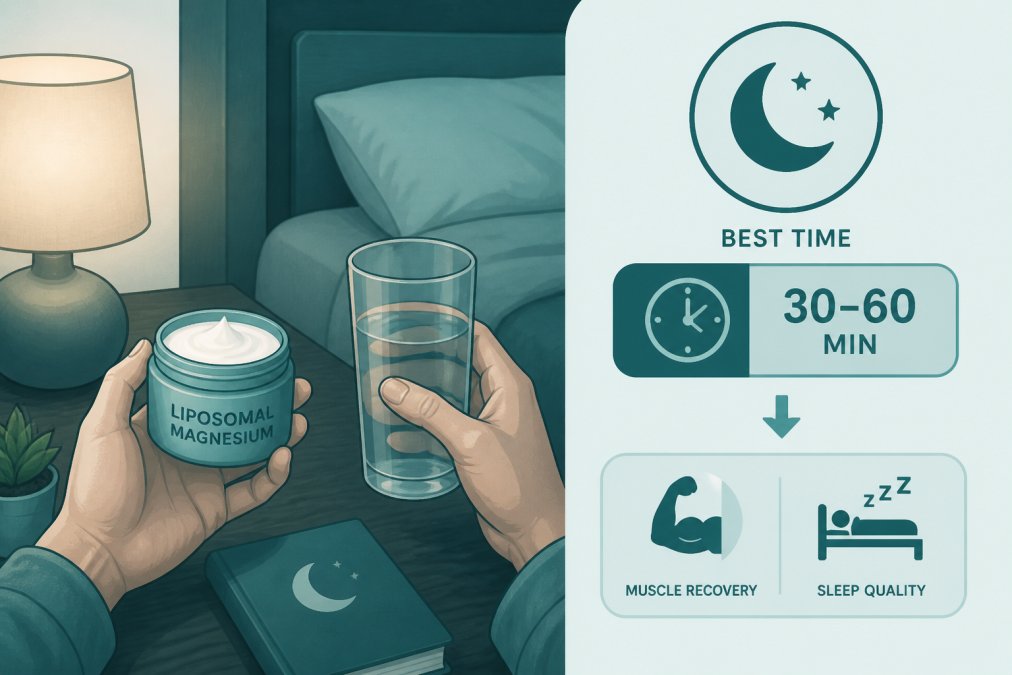
Post-workout timing is the second-best window, particularly for topical liposomal application. Muscle blood flow is elevated immediately after exercise, which may enhance transdermal delivery to tissues with greatest metabolic demand. For oral liposomal magnesium, post-workout application is reasonable but evening timing remains the priority for recovery optimization.
A practical protocol for athletes:
- Post-workout (within 30 minutes): Apply topical liposomal magnesium to primary muscle groups trained
- Evening (60-90 minutes before sleep): Take oral liposomal magnesium if using both forms
- Consistency over precision: Daily consistency matters more than exact timing
Avoid taking magnesium at the same time as zinc supplements or the antibiotics mentioned above. Morning is the better window for those nutrients if evening magnesium is your recovery protocol.
Topical Liposomal Magnesium: A Targeted Delivery Option
Topical liposomal magnesium represents a genuinely different delivery strategy, not just a cosmetic variation of oral supplementation. Transdermal magnesium delivery bypasses the gastrointestinal system entirely, eliminating both the absorption ceiling and tolerance issues of oral forms.
The mechanism depends on liposomal encapsulation quality. Standard magnesium creams apply magnesium salts to skin surface, where absorption is limited by the stratum corneum's barrier function. Liposomal encapsulation changes this: the phospholipid vesicle fuses with skin cell membranes, allowing magnesium to enter the dermis and reach local circulation.
This targeted delivery has practical advantages for athletes managing acute muscle soreness or cramps in specific muscle groups. Applying directly to a cramping calf or sore quadriceps concentrates the mineral at the site of demand rather than distributing it systemically.
Aftology's liposomal magnesium cream uses a patent-pending gel matrix specifically designed for transdermal delivery. The formulation provides deep moisturization without sticky residue, important for athletes applying it before sleep or before a second training session. The sustained mineral release profile means gradual absorption over time, which better mirrors how the body uses magnesium for ongoing cellular repair.
For athletes skeptical about transdermal magnesium absorption, evidence is growing. As covered in research reviewed by the journal Nutrients, transdermal magnesium absorption is plausible and potentially clinically meaningful, though oral and topical forms are likely best used as complementary strategies.
Muscle recovery stalls when the underlying mineral deficiency driving it goes unaddressed. For athletes who have tried conventional magnesium supplements and found them either ineffective or hard to tolerate, the delivery system is the variable worth changing. Aftology's liposomal magnesium cream delivers elemental magnesium through a patent-pending transdermal system designed for genuine bioavailability. Shop Liposomal Magnesium Cream and build a supplementation protocol that actually reaches the muscle tissue doing the work.
Frequently Asked Questions
Is liposomal magnesium more effective than magnesium glycinate for muscle recovery?
Both forms outperform basic magnesium oxide, but they work differently. Magnesium glycinate is well-tolerated orally and has solid absorption data. Liposomal magnesium uses phospholipid encapsulation to protect elemental magnesium from degradation in the gut, which research suggests produces higher systemic absorption rates. For athletes focused specifically on post-workout recovery and gastrointestinal tolerance, liposomal delivery offers a meaningful advantage, particularly when applied topically to target muscle tissue directly.
Does magnesium actually work for muscle recovery?
Yes, and the mechanism is well-documented. Magnesium is essential for muscle contraction and relaxation, nerve signaling, protein synthesis, and electrolyte balance, all processes central to post-workout recovery. Deficiency is associated with increased muscle cramps, fatigue, and prolonged DOMS. Randomized controlled trials show that adequate magnesium status correlates with faster recovery times and reduced muscle tissue inflammation. The key variable is whether the form you take delivers enough elemental magnesium to actually raise tissue levels.
What is the best time to take magnesium for muscle recovery?
Post-workout and pre-sleep are the two windows with the strongest rationale. Immediately after exercise, magnesium supports cellular repair and protein synthesis when metabolic demand is highest. Pre-sleep dosing takes advantage of magnesium's role in neuromuscular relaxation and the body's overnight recovery processes. For topical liposomal magnesium, applying directly to worked muscle groups right after training allows localized absorption during the active recovery window.
Are there any side effects or drug interactions to be aware of with magnesium supplements?
High oral doses of magnesium can cause loose stools or gastrointestinal discomfort, one reason liposomal and topical forms are preferred by athletes taking therapeutic dosages. More importantly, magnesium interacts with several medications. It can reduce absorption of certain antibiotics (tetracyclines, fluoroquinolones) and bisphosphonates. It also affects how the body processes some anticonvulsants, including lamotrigine. Anyone on prescription medication should consult a healthcare provider before starting a magnesium supplementation protocol.
This article was written using GrandRanker