

Table of Contents
- What Nano-Hydroxyapatite May Support
- Hydroxyapatite, Fluoride, and Dry Mouth
- Building a Dry-Mouth Care Routine
- Daily Use, Tolerance, and Safety
- Considering the Complete Formula
- Concentration and Particle Characteristics
- Frequently Asked Questions
Last Updated: October 6, 2026
What Nano-Hydroxyapatite May Support
Nano-hydroxyapatite is a calcium-phosphate mineral similar to the mineral in teeth. It may support remineralization and may help cover exposed dentin tubules, potentially helping manage sensitivity. Tubules are in dentin, not enamel. These potential effects do not establish guaranteed deep repair or a treatment for dry mouth itself.
Saliva helps buffer acids and supports mineral balance. Reduced saliva can increase the risk of tooth decay and oral discomfort. Hydroxyapatite toothpaste should not be described as replacing saliva's functions, restoring saliva flow, or correcting the underlying cause of xerostomia.

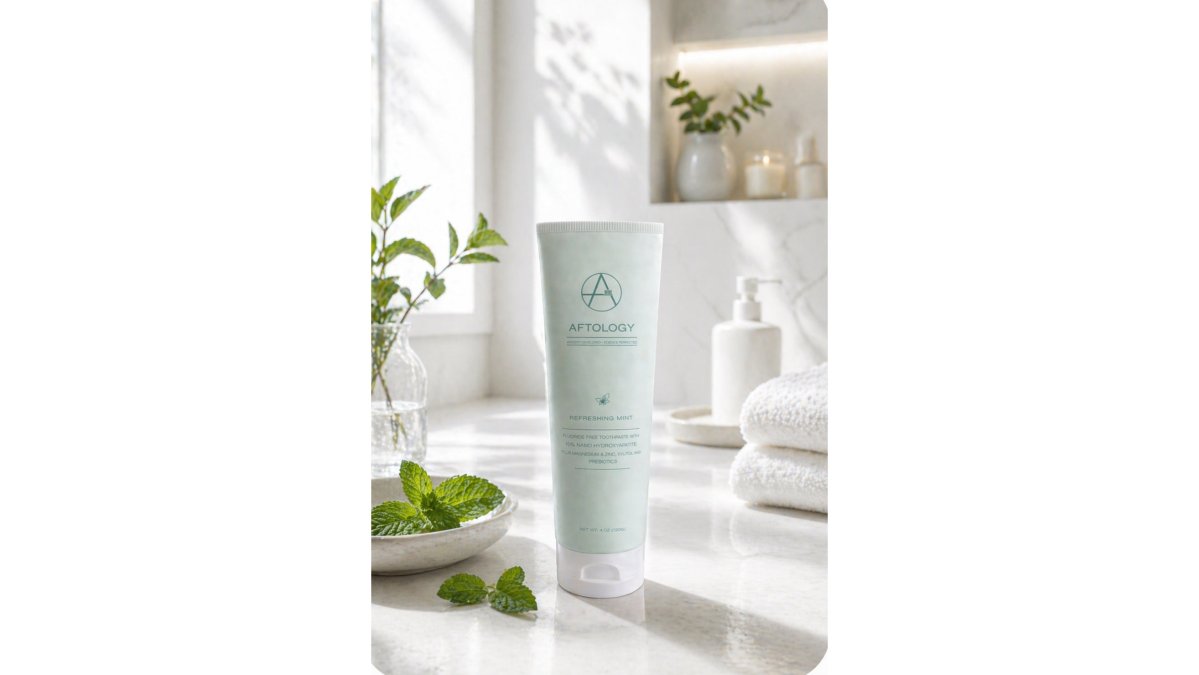
Aftology's 10% nano-hydroxyapatite toothpaste uses 20 nm rods as a deliberate formulation choice. Particle size matters alongside shape, dispersion, concentration, and the complete formula. Neither smaller size nor a 10% concentration alone establishes superior results or suitability for every dry-mouth patient.
Toothpaste may support care for remaining tooth structure, but cannot regrow missing enamel or restore a developed cavity. Sensitivity, new decay, or persistent dry mouth deserves professional assessment.
Hydroxyapatite, Fluoride, and Dry Mouth
Fluoride supports remineralization and has established evidence for cavity prevention. Hydroxyapatite is studied for mineral deposition and sensitivity management. Comparisons require evidence for specific formulas, populations, and outcomes.
Reduced saliva does not establish that fluoride becomes ineffective or should no longer be a primary preventive option. Your dentist may recommend additional preventive care when dry mouth raises cavity risk.
Nano-hydroxyapatite toothpaste should not be described as working independently of saliva, delivering faster relief for every xerostomia patient, or universally matching fluoride's cavity protection. Choosing fluoride-free care is a formulation preference, not proof of superiority.
Building a Dry-Mouth Care Routine
A useful routine addresses symptoms, tooth health, and the underlying cause. Persistent dryness may be associated with medications, medical conditions, or treatment effects. Ask your dentist or clinician for an assessment.
Medication review
If dryness began or worsened after a medication change, speak with your prescriber or pharmacist. Do not stop, substitute, or adjust a prescribed medicine on your own. An ingredient's mineral-delivery mechanism does not bypass medication-related salivary gland dysfunction.
Fluoride-free mineral toothpaste may be considered within a suitable dental routine, but does not establish treatment of medication-induced xerostomia.
Daily oral care
Brush gently for two minutes, twice daily, using an appropriate amount according to product directions and dental advice. Clean between teeth using a suitable method. More paste or longer contact time does not guarantee mineral uptake or faster results.
Sip water for comfort as appropriate to your medical needs. Follow any fluid restrictions rather than using a universal daily water target. Sugar-free gum or lozenges may stimulate residual saliva for some people; ask about suitability and follow product directions rather than using a universal xylitol dose.
Food and drink
Limit frequent sugary drinks and repeated acidic exposures. Balanced nutrition supports health but does not guarantee enamel repair. Ask your dental team about brushing timing after reflux, vomiting, or acidic foods.
Nighttime comfort
A dentist or pharmacist may suggest saliva substitutes or moisturizing products. These may offer symptom relief, but should not be presented as guaranteeing prevention of overnight mineral loss.
Daily Use, Tolerance, and Safety
Suitability depends on the complete formula, particle characteristics, intended use, and the person using it. Similarity to tooth mineral does not establish zero absorption, zero toxicity, or an absence of adverse effects.
Nano-Hydroxyapatite Toothpaste →
Abrasiveness and tolerance
Abrasiveness depends on the complete formula, not whether a toothpaste contains fluoride or hydroxyapatite. Relative Dentin Abrasivity is one measure to discuss with your dentist when exposed dentin is a concern. An ingredient name alone does not establish that a product is gentler.
Flavorings, surfactants, and other ingredients can affect individual tolerance. Fluoride-free does not automatically mean SLS-free, and neither category guarantees comfort or microbiome benefits. If a product causes burning, irritation, or sores, stop using it and seek advice rather than assuming symptoms are temporary adaptation.
Choosing toothpaste for sensitive teeth should include attention to symptoms and the underlying cause, not just the remineralizing ingredient.
Medicines and tissue changes
This guide does not establish universal compatibility with medicines or oral treatments. Ask your dentist or pharmacist how to coordinate toothpaste with prescribed oral products and follow those medicines' directions.
Persistent sores, white patches, burning, bleeding, or swelling need assessment. Toothpaste should not be described as treating infection or stabilizing gum tissue. Do not intentionally swallow toothpaste; follow age restrictions and supervise children.
Considering the Complete Formula
Hydroxyapatite, desensitizing ingredients, flavorings, surfactants, and humectants serve different roles. Their combination does not automatically establish enhanced remineralization, dry-mouth relief, or cavity protection.
Potassium nitrate is used in some sensitivity formulas. Glycerin and sorbitol are humectants used in toothpaste, but their presence or percentage alone does not prove clinical xerostomia relief. Xylitol-containing gum or lozenges may be useful for some people, but this guide does not establish a required toothpaste percentage or guaranteed synergy.
Concentration and Particle Characteristics
Aftology uses 10% nano-hydroxyapatite and 20 nm rods. These are deliberate specifications, not a universal effectiveness threshold or an optimal size established for every outcome.
Lower concentrations and larger particles should not be dismissed without relevant comparative studies. Assess concentration together with size, shape, dispersion, the complete formula, and evidence relevant to your dental needs.
Frequently Asked Questions
How may nano-hydroxyapatite support sensitive teeth with dry mouth?
It may support remineralization and may help cover exposed dentin tubules, potentially helping manage sensitivity. Tubules are in dentin, not enamel. It does not restore saliva flow, treat every cause of pain, or regrow missing enamel. Dry mouth and persistent sensitivity deserve assessment.
Is nano-hydroxyapatite toothpaste suitable for daily use?
Follow the complete product's directions and your dental team's advice. Ingredient similarity to tooth mineral does not prove safety for everyone, zero absorption, or an absence of adverse effects. Seek advice for irritation and ask before replacing recommended fluoride care when dry mouth raises cavity risk.
How long does it take to see results?
There is no fixed timeline that applies to every person. Results depend on the formula and the cause of symptoms. A purchase guarantee is not clinical evidence of a result window. Persistent or worsening symptoms need assessment rather than waiting through a promised improvement period.
What do concentration and particle size tell me?
Aftology uses 10% nano-hydroxyapatite and 20 nm rods as deliberate formulation choices. Size matters alongside shape, dispersion, concentration, and the complete formula. Neither specification alone establishes superiority, a universal effectiveness threshold, or suitability for every dry-mouth patient.