

Table of Contents
- Remineralization
- Repair Limits
- Hydroxyapatite and Fluoride
- Results and Timing
- Formulation
- Daily Use
- Safety
- Frequently Asked Questions
Last Updated: October 8, 2026
How Hydroxyapatite May Support Remineralization
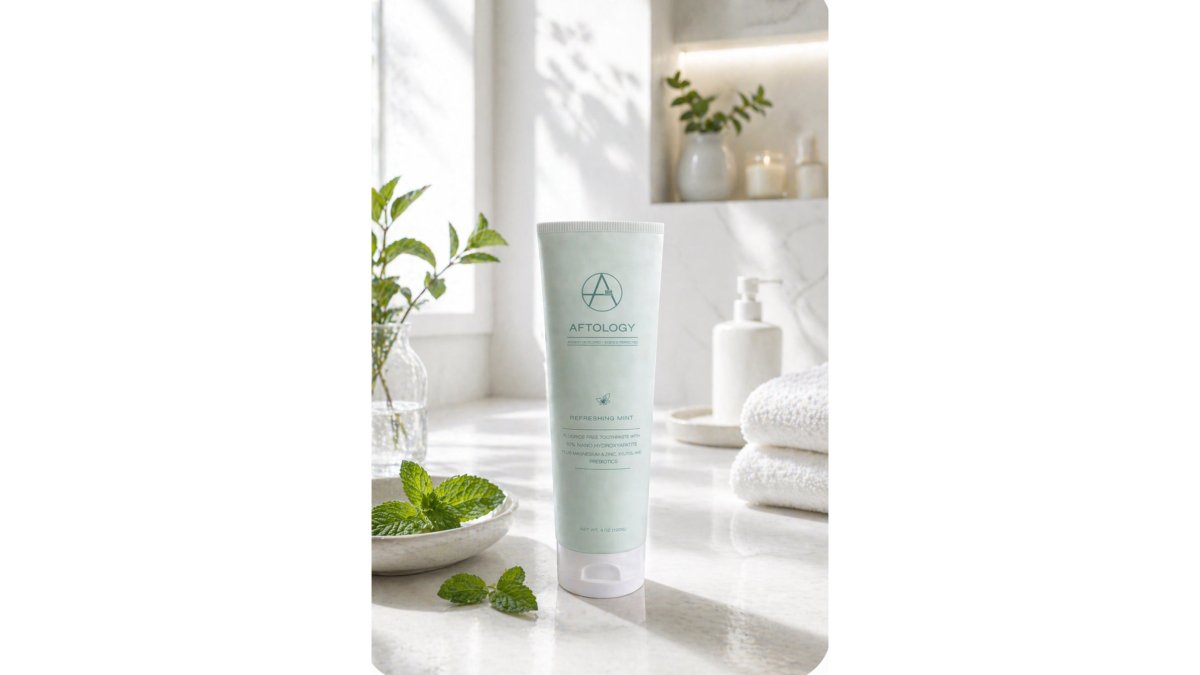
Hydroxyapatite is a calcium-phosphate mineral similar to the mineral in teeth. A suitable formulation may support remineralization. Aftology uses 10% nano-hydroxyapatite as a deliberate formulation choice, not a guaranteed repair dose.

What Enamel Can and Cannot Do
Early demineralized areas may recover minerals under suitable conditions. That is different from regrowing enamel that has been physically lost. Toothpaste cannot replace missing tooth structure or repair cracks.
Does Hydroxyapatite Rebuild Enamel?
Remineralization should not be described as regrowth of an enamel layer. Hydroxyapatite may support early mineral recovery, but does not restore a developed cavity, a chip, or extensive wear.
Interpreting Research
Hydroxyapatite research should be evaluated by the formulation, population, and outcome studied. Ingredient-level findings do not establish every finished product's effectiveness or guaranteed results.
Hydroxyapatite and Fluoride
Potential Mechanisms
Fluoride supports remineralization and resistance to acid-related mineral loss, with established cavity-prevention evidence. Hydroxyapatite may support remineralization and may help cover exposed dentin tubules. Tubules are in dentin, not enamel.
Evidence Depends on the Outcome
Comparisons require specific formulations and outcomes. Similarity to tooth mineral does not establish universal equivalence to fluoride, superior safety, or better cavity protection.
Sensitivity Support
Covering exposed dentin tubules may help manage sensitivity, but not every toothache is dentin hypersensitivity. Sensitivity formulas have different ingredients and mechanisms; fluoride alone should not be presented as relieving pain simply by hardening enamel.
Cavity-Prevention Needs
Ask before replacing recommended fluoride care, especially with active decay, dry mouth, exposed roots, or other risk factors. Hydroxyapatite is not an FDA-approved OTC anticavity active; fluoride ingredients have that status.
Using More Than One Product
Discuss a suitable routine with your dental team rather than assuming morning-and-night alternation or adding a rinse is necessary. Follow each product's directions about use and rinsing. A reaction to a toothpaste does not establish that fluoride caused it.
Results and Timing
Response varies with the cause of symptoms, the complete formula, oral conditions, and use. This guide does not promise relief within two to four weeks or visible improvement within four to eight weeks.
Skipping a day does not establish that progress resets. Do not wait through a mandatory two-to-three-month toothpaste trial when symptoms are new, persistent, worsening, or significant. Sensitivity improvement alone does not prove enamel repair.
Concentration, Particle Size, and Formulation
Concentration in Context
Ten percent is not a universal effectiveness threshold. A higher percentage does not automatically mean better results, and lower concentrations should not be dismissed without relevant comparative evidence. A disclosed percentage is informative, not proof of performance.
Nano-Hydroxyapatite Toothpaste →
Aftology's Particle Choice
Aftology deliberately uses 20 nm rod-shaped nano-hydroxyapatite particles. Particle size matters alongside shape, dispersion, concentration, and the complete formula. Smaller size alone does not guarantee superior outcomes for every product, and a nano-versus-micro label alone cannot establish clinical performance.
The Complete Formula
The base and particle dispersion influence a formulation's properties. A gel label or patent-related description alone does not prove sustained mineral release, greater retention, or superior repair. Those claims need relevant testing.
Comparing Products
Review ingredients, concentration where disclosed, particle specifications, directions, and evidence supporting the actual claims. Consider personal tolerance and dental needs rather than assuming every natural, SLS-free, or fluoride-free product is gentle.
Limits of Specifications
Formulation details cannot predict an individual's response or diagnose the cause of pain. Mineral similarity does not guarantee seamless integration or deep repair.
Daily Use
Brush twice daily for two minutes using a soft-bristled brush and light pressure. Follow product and age directions for amount, rinsing, and supervision. Spit rather than intentionally swallowing toothpaste.
Avoiding Overstated Routine Rules
Do not assume that extra toothpaste, longer contact, or a universal waiting interval will improve outcomes. Ask about brushing timing after acidic exposures. Gentle technique supports care but cannot guarantee prevention of all wear or recession.
When Assessment Is Needed
Persistent or worsening pain, pain on biting, swelling, bleeding, or suspected damage needs assessment. Symptoms alone do not establish a diagnosis. Toothpaste cannot fill cavities or repair cracks, and relief does not rule out an underlying problem.
Safety and Use Directions
The 2023 SCCS opinion's up-to-10% toothpaste safety conclusion applies to specified uncoated, non-surface-modified rod-shaped particles under its stated conditions, not every hydroxyapatite material or complete formula. It excludes needle-shaped particles and sprayable uses involving inhalation exposure. A safety assessment is not an effectiveness threshold or blanket pregnancy or swallowing clearance.
Read our safety discussion alongside product directions. Fluoride-free does not mean safe to swallow or suitable for every child. Check confirmed allergens, supervise as appropriate, and seek advice about reactions or specific health concerns.
Frequently Asked Questions
Can hydroxyapatite regrow enamel?
It may support remineralization of early mineral loss, not regrowth of missing enamel, restoration of cavities, or repair of cracks.
How quickly will sensitivity improve?
Response varies, with no guaranteed schedule. Do not delay assessment of persistent, worsening, or significant symptoms while completing a fixed toothpaste trial.
Is 10% always more effective?
No universal threshold is established here. Shape, size, dispersion, concentration, and the complete formula all matter; comparative evidence is needed to rank products.
Does fluoride-free mean safe to swallow?
No. Follow product and age directions, supervise children as appropriate, and spit rather than intentionally swallowing.
Aftology's 10% nano-hydroxyapatite toothpaste uses 20 nm rods as deliberate formulation choices. Explore the product without treating those specifications as promises of sustained release, guaranteed repair, or a fixed result timeline.