

Table of Contents
- What Is Nano-Hydroxyapatite?
- Hydroxyapatite and Fluoride
- Safety Evidence and Its Limits
- Side Effects and When to Seek Advice
- Potential Benefits
- Using Toothpaste as Directed
- Regulatory Status and the 2023 SCCS Opinion
- Frequently Asked Questions
What Is Nano-Hydroxyapatite?
Nano-hydroxyapatite is a calcium phosphate mineral with a structure similar to the mineral in teeth. In toothpaste, it may support mineral deposition in early demineralized areas and help cover exposed dentin tubules, potentially reducing sensitivity. These potential effects depend on the complete formulation and the condition being addressed.
Enamel and dentin have different structures. Dentin contains tubules; the phrase enamel tubules should not be used to imply a proven mechanism of deep repair. Remineralization is not the same as regrowing missing enamel or restoring a developed cavity.
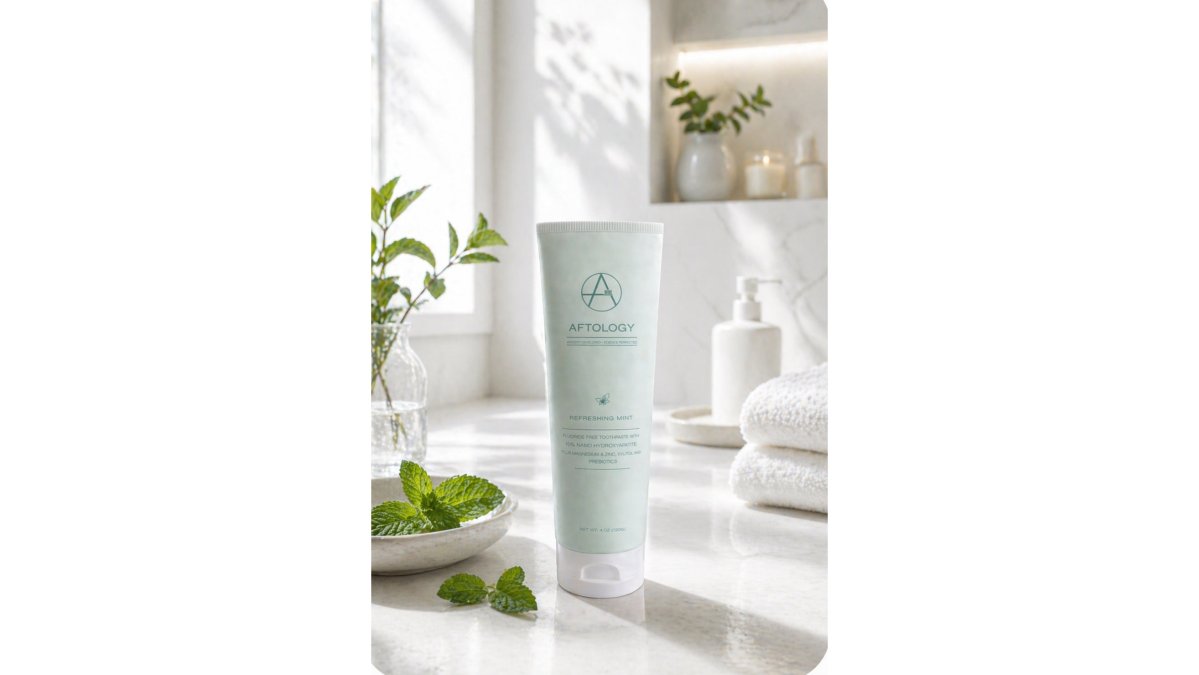
Aftology's toothpaste contains 10% nano-hydroxyapatite and uses 20 nm rods as a deliberate formulation choice. Particle size and shape matter to formulation design, alongside concentration, dispersion, and other ingredients. Neither specification alone guarantees optimal performance or superiority over another finished product.

Aftology's 10% Nano-Hydroxyapatite Toothpaste should not be described as crossing a universal effectiveness threshold. Lower concentrations may also offer benefits, and larger particles should not be dismissed without a relevant comparative study. Claims of active remineralization rather than surface coating need evidence for the specific formulation and outcome measured.
Hydroxyapatite and Fluoride
Fluoride supports remineralization and has established evidence for cavity prevention. Hydroxyapatite is studied for mineral deposition and sensitivity management. Their mechanisms differ, but fluoride should not be described as merely forming a barrier or as unable to support early mineral repair.
Evidence relevant to hydroxyapatite toothpaste should identify the tested formula, comparison, and outcome. A laboratory mineral change is not automatically proof of fewer cavities in people. Discuss your cavity risk with your dentist before replacing a recommended fluoride routine.
Safety Evidence and Its Limits
Safety of nano-hydroxyapatite toothpaste depends on the material, complete formula, exposure, and conditions of use. Similarity to tooth mineral is not proof of no systemic exposure, no allergic reactions, or suitability for every person.
The 2023 EU Scientific Committee on Consumer Safety opinion, SCCS/1648/22 concluded that the hydroxyapatite (nano) assessed was safe up to 10% in toothpaste under the conditions reviewed. That finding is qualified by specific particle characteristics and should not be generalized to every nano-hydroxyapatite ingredient.
Particle Size, Shape, and Solubility
Aftology uses 20-nanometer rod-shaped nano-hydroxyapatite particles, at the fine end of the 20-to-100-nanometer range described in oral-care research. Smaller rod-shaped particles have more surface area and closely resemble the mineral structure of natural enamel, which may help them bind to the tooth surface and reach areas that larger, more clumped particles penetrate less effectively. This is a deliberate formulation choice. Particle size is one factor among several, and smaller size alone does not guarantee a better outcome for every product.
The SCCS conclusion applies to uncoated, non-surface-modified rod-shaped particles: at least 95.8% by particle number must have an aspect ratio below 3, with the remaining 4.2% not exceeding 4.9. It does not apply to needle-shaped particles or sprayable products that could expose the lungs to nanoparticles.
A size statement such as 20 nm or a concentration of 10% alone does not establish compliance with every specification. Particle properties are relevant, but should not be used to guarantee an absence of absorption or harm.
Systemic Exposure
Exposure through oral tissues and exposure after swallowing are different questions. The extent of absorption cannot be established from a particle-size statement alone. Claims of no organ accumulation, negligible kidney or liver burden, or safety at multiples of toothpaste doses require a specific study and an explanation of how its findings apply to actual toothpaste use.
This article does not make an unsupported FDA classification claim about systemic toxicity. Follow product directions, spit out toothpaste, and avoid intentional swallowing.
The Complete Formulation
Paste, gel, powder, and suspension formulations may differ in dispersion, contact, and exposure. Those differences should be assessed rather than assumed. No quantified reduction in systemic exposure is claimed here without a specific comparative study.
Nano-Hydroxyapatite Toothpaste →
What a Safety Assessment Means
A safety conclusion applies to the material, exposure conditions, and uses assessed. It is not proof of zero risk, pregnancy-specific clearance, or approval as an anticavity drug. Laboratory and animal findings should not be treated as interchangeable with clinical evidence for a finished product.
Side Effects and When to Seek Advice
A finished toothpaste contains more than hydroxyapatite. Irritation or reactions may relate to flavors, foaming agents, or other ingredients. Do not assume symptoms are a normal adjustment or evidence that remineralization is working.
Gum Irritation
Burning, soreness, bleeding, or swelling should not be attributed to microbiome adjustment without assessment. Stop using a formula that appears to irritate your mouth and ask your dentist about persistent symptoms.
Allergic Reactions
Biocompatibility does not guarantee that reactions cannot occur. Check the complete ingredient list if you have known allergies. Seek urgent medical help for breathing difficulty or rapidly developing swelling of the lips, tongue, or throat.
New or Worsening Sensitivity
Increased sensitivity is not proof of active enamel repair. Persistent, sharp, or worsening pain can have causes that toothpaste cannot address. Seek dental advice rather than continuing through a fixed adjustment period.
Changes in Tooth Appearance
Changes in color, opacity, texture, or visible damage deserve dental assessment. Appearance alone cannot establish whether remineralization is occurring or whether a toothpaste is responsible.
Swallowed Toothpaste
Spit out toothpaste and discourage swallowing. Supervise children and follow age guidance. If a substantial amount is swallowed or symptoms develop, contact a clinician or poison control for advice appropriate to the product and amount.
When to Discontinue Use
Stop using a product that appears to cause irritation or a reaction, and seek advice for persistent pain, ulcers, bleeding, or swelling. Do not wait several weeks if symptoms are severe or worsening.
Potential Benefits
Hydroxyapatite may support early remineralization and help manage sensitivity associated with exposed dentin. Results vary with the formula, routine, and underlying condition. For enamel erosion, it is important to address acid exposure and assess structural loss. Toothpaste cannot regrow missing enamel or restore a developed cavity.
Using Toothpaste as Directed
Brush twice daily with gentle technique, clean between teeth, and follow product directions. Spit out toothpaste, supervise children, and continue dental reviews at the interval recommended for you. Ask your care team about suitability during pregnancy or for individual medical concerns.
Regulatory Status and the 2023 SCCS Opinion
Hydroxyapatite's recognition as safe for specified food-additive uses is separate from toothpaste regulation. Food-additive GRAS status is not approval as a toothpaste ingredient or as an anticavity active ingredient.
In the US, toothpaste marketed for ordinary cleaning without drug claims is generally a cosmetic. Hydroxyapatite is not an FDA-approved OTC anticavity active ingredient; fluoride ingredients hold that status. Claims to prevent or treat cavities can affect a product's regulatory classification.
The March 2023 SCCS opinion found the specified hydroxyapatite (nano) safe up to 10% in toothpaste under the conditions assessed. This is a qualified safety finding, not evidence that 10% is the minimum effective concentration, a guarantee for every finished product, or pregnancy-specific clearance.
Frequently Asked Questions
Does nano-hydroxyapatite get into your bloodstream?
Particle size alone does not establish the extent of systemic exposure or prove that absorption is impossible. The 2023 SCCS safety conclusion applies to the specified material and conditions reviewed. Use toothpaste as directed, spit it out, and avoid intentional swallowing. This article does not attribute an unsupported systemic-toxicity classification to the FDA.
How does nano-hydroxyapatite compare to fluoride for enamel remineralization?
Fluoride supports remineralization and has established evidence for cavity prevention. Hydroxyapatite may support mineral deposition and sensitivity management. Comparisons depend on the specific formulas and outcomes; neither concentration nor particle size alone establishes equivalence or superiority.
Are there any known side effects of using nano-hydroxyapatite toothpaste?
A toothpaste may cause irritation or reactions depending on its complete formulation and individual sensitivity. Do not assume worsening pain, inflammation, or swelling is evidence of healing. Stop using an irritating formula and seek dental advice; breathing difficulty or rapidly developing facial or throat swelling requires urgent medical help.
Is nano-hydroxyapatite FDA approved for use in toothpaste?
Hydroxyapatite is not an FDA-approved OTC anticavity active ingredient; fluoride ingredients hold that status. Recognition as safe for specified food-additive uses is not toothpaste approval. A toothpaste marketed for ordinary cleaning without drug claims is generally a cosmetic, while anticavity claims can affect its regulatory classification. For a qualified oral-cosmetic safety assessment, see the 2023 SCCS opinion, which found the specified hydroxyapatite (nano) safe up to 10% in toothpaste under the conditions reviewed.
What concentration of nano-hydroxyapatite is considered safe?
The 2023 SCCS opinion, SCCS/1648/22 found the specified uncoated, non-surface-modified rod-shaped hydroxyapatite (nano) safe up to 10% in toothpaste under the conditions assessed. It does not cover needle-shaped particles or sprayable products. Concentration alone does not establish compliance with every specification. The 10% safety finding is not a universal effectiveness threshold, and lower concentrations should not be dismissed without relevant comparative evidence.