

Table of Contents
- What Are Nano-Hydroxyapatite and Calcium Phosphate?
- Particle Size and Bioavailability
- Remineralization Potential and Its Limits
- Daily Use
- Safety Considerations
- Hydroxyapatite and Fluoride
- Which Should You Choose?
- Frequently Asked Questions
What Are Nano-Hydroxyapatite and Calcium Phosphate?
Nano-hydroxyapatite is a form of calcium phosphate with nanoscale particles and a mineral structure similar to the mineral in teeth.
Calcium phosphate is a broader category that includes hydroxyapatite, dicalcium phosphate, and tricalcium phosphate. The comparison is therefore between one type of calcium phosphate and other calcium phosphate ingredients, not two completely separate mineral families.
Particle size, mineral form, solubility, and the complete formulation can affect how these ingredients interact with tooth surfaces. No single particle size or concentration establishes which product is best for every dental need.
Nano-Hydroxyapatite: Composition and Structure
Hydroxyapatite resembles the mineral component of enamel and dentin. It is studied for mineral deposition, support for early demineralized areas, and sensitivity management.
Particle characteristics can influence performance, but a size such as 20 nanometers is not proof of universally optimal performance. Larger particles should not be dismissed as ineffective without studies relevant to the specific formulations.
Aftology's toothpaste contains 10% nano-hydroxyapatite. Ten percent should not be presented as a universal minimum or effectiveness threshold. Lower concentrations may also offer benefits; meaningful comparisons require evidence for the complete products and the outcomes measured.

Calcium Phosphate: Forms and Function
Different calcium phosphate ingredients have different properties and roles. Depending on the formulation, they may supply mineral ions, contribute to cleaning, or support remineralization. The ingredient category alone does not reveal the extent of a product's clinical benefit.
Solubility and delivery vary by mineral form and formula. A label that lists calcium phosphate without further detail does not, by itself, prove that the ingredient is merely a filler or that the product is ineffective.
Particle Size and Bioavailability
Particle characteristics and the surrounding formula can influence contact with tooth surfaces and mineral deposition. Avoid treating particle size alone as a guarantee of deeper repair or superior sensitivity relief.
Dentin contains tubules; enamel has a different structure. Claims about penetration should identify which tissue and outcome were studied rather than referring broadly to enamel tubules.
Understanding Product Labels
Look for clear information about the mineral form, concentration, directions, and the evidence supporting a claimed benefit. Transparency helps you evaluate a product, but a disclosed percentage or particle size is not itself clinical proof.
For both hydroxyapatite and other calcium phosphate ingredients, performance depends on the complete formula. A lower percentage does not automatically mean surface-only action, and a higher percentage does not automatically mean better results.
Evaluating Claims
Useful evidence should identify the specific formulation, comparison product, duration, participants or laboratory model, and outcome. Laboratory mineral deposition is not automatically equivalent to fewer cavities in people.
- Mineral form: Which ingredient was tested?
- Concentration: Was the tested formulation the same as the product being sold?
- Particle characteristics: Were size and shape assessed rather than assumed?
- Outcome: Did the study measure sensitivity, mineral changes, or cavity prevention?
For more context on the limits of enamel repair, distinguish early remineralization from restoring tooth structure that is already missing.
Remineralization Potential and Its Limits
Remineralization replaces minerals lost during early demineralization. Hydroxyapatite and other calcium phosphate systems are studied for supporting this process, but results depend on the formula and conditions tested.
Neither toothpaste nor mineral deposition can regrow missing enamel or restore a developed cavity. Changes in laboratory microhardness should not be presented as a guarantee of structural repair in every person.
Daily Use
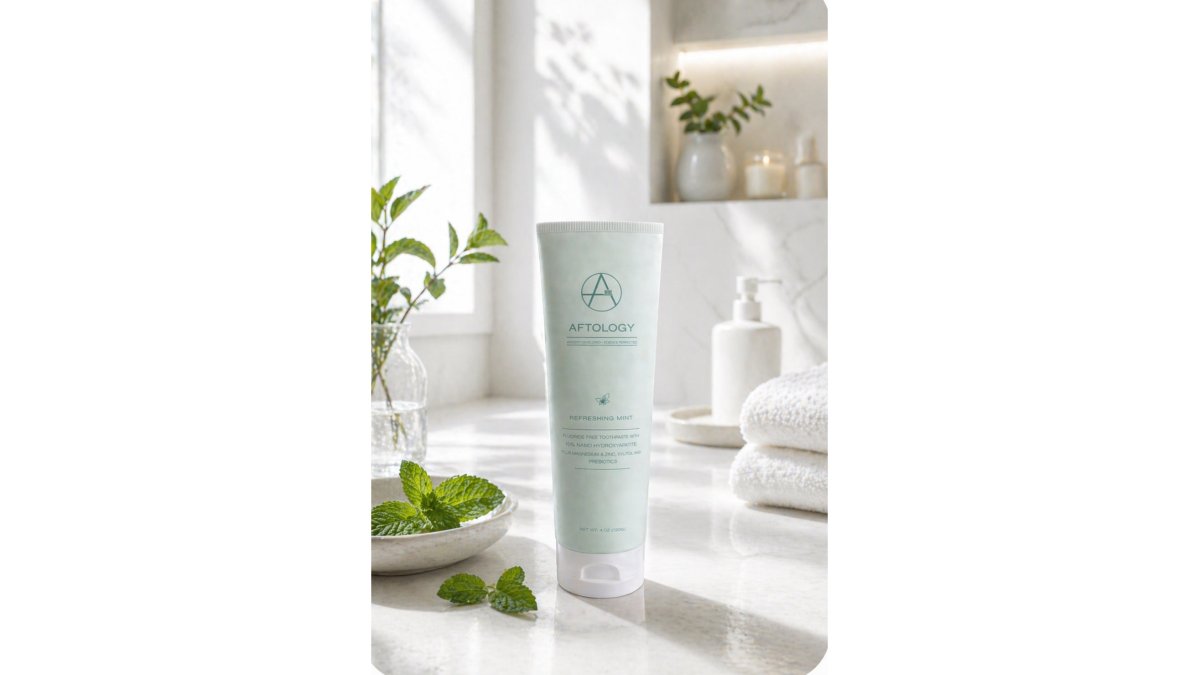
Hydroxyapatite toothpaste may support remineralization and sensitivity management as part of a consistent oral-care routine. Aftology contains 10% nano-hydroxyapatite, but that percentage alone does not guarantee a specific clinical result.
Follow product directions, brush gently, clean between teeth, and continue dental visits. Do not wait for a promised improvement timeline if symptoms persist or worsen.
Safety Considerations
The 2023 SCCS opinion on hydroxyapatite (nano) found the material assessed safe up to 10% in toothpaste under the conditions reviewed. This conclusion applies to specified uncoated, non-surface-modified rod-shaped particles: at least 95.8% must have an aspect ratio below 3, with the remainder not exceeding 4.9. Needle-shaped particles and sprayable products were not covered by that conclusion.
A 10% concentration alone does not establish that a product meets all those specifications. This general safety assessment is not pregnancy-specific clearance, and particle size alone should not be used to guarantee no systemic exposure or no adverse reactions.
Read product directions, avoid intentional swallowing, and supervise children. If you are pregnant, choosing a child's toothpaste, or managing irritation or a medical condition, ask your dental care team about suitability. For sensitive teeth, the complete formula and the cause of symptoms matter.
Nano-Hydroxyapatite Toothpaste →
Hydroxyapatite and Fluoride
Fluoride supports remineralization and has established evidence for cavity prevention. It should not be described as only hardening the surface or as unable to support early mineral repair.
Hydroxyapatite is studied for mineral deposition and sensitivity management. Claims of faster relief or greater efficacy need a study comparing the specific formulations and outcomes.
If you prefer fluoride-free options, discuss your cavity risk with your dentist rather than assuming hydroxyapatite is an interchangeable replacement in every situation.
Which Should You Choose?
Choose according to your dental needs, the complete formulation, relevant evidence, and professional advice. An ingredient name alone cannot establish a universal winner.
Dental Needs
Sensitivity or erosion: Ask your dentist to assess the cause. Hydroxyapatite may help sensitivity, but missing tooth structure and some causes of pain require treatment.
Mineral support: Compare evidence for specific hydroxyapatite or other calcium phosphate products rather than dismissing an entire category.
Inflamed gums: A gentle formula may be more comfortable, but persistent bleeding or swelling needs assessment.
Cost and Value
Higher concentration or price does not automatically mean better value. Consider evidence, comfort, directions, and whether a product addresses your actual needs. A lower-cost or lower-concentration product should not be dismissed without a relevant comparison.
Combining Products
Using several mineral products does not automatically improve results. Evidence for individual ingredients is not proof of added benefit from combining finished products. Ask your dentist before adding complexity to your routine, especially if you are managing active symptoms.
Practical Recommendation
Look for transparent ingredients, clear directions, and research relevant to the formulation and your intended outcome. Do not use 10% or 20 nanometers as a universal pass-or-fail rule.
A subscription may make replenishment convenient, but it does not replace dental advice or guarantee treatment results.
Frequently Asked Questions
What is the difference between nano-hydroxyapatite and calcium phosphate?
Nano-hydroxyapatite is one form of calcium phosphate. Other forms have different properties and roles. Product performance depends on the complete formula, not the category name or particle size alone.
Is nano-hydroxyapatite safe for daily use?
The 2023 SCCS opinion supports safety of the specified material up to 10% in toothpaste under the conditions assessed. It is not a guarantee for every nano-hydroxyapatite formula or pregnancy-specific clearance. Follow directions and ask your dentist about suitability.
Which is more effective for remineralization?
There is no universal winner based on ingredient category, concentration, or particle size alone. Ten percent is not a universal effectiveness threshold, and lower concentrations may also offer benefits. Comparisons need studies of the specific formulas and outcomes.
Can nano-hydroxyapatite replace fluoride for cavity prevention?
Do not assume it is a suitable replacement for everyone. Fluoride has established evidence for cavity prevention; hydroxyapatite evidence depends on the formulation and outcome studied. Ask your dentist about your cavity risk before changing a recommended preventive routine.
If erosion or sensitivity persists, seek dental advice. Explore Aftology's 10% nano-hydroxyapatite toothpaste as one option for your routine. Subscribe and save 10% if regular replenishment suits you, without treating a subscription as a substitute for needed care.